


Japan’s kei truck market may be entering a more serious phase of electrification. Suzuki has begun real-world testing of a battery-electric kei truck based on the Carry, working directly with farmers across several regions of Japan. For North American readers, this matters not because electric kei trucks are about to flood the U.S. market, but because it shows where the segment could be headed next: quieter work vehicles, V2H-based energy backup, and EV utility designed around real job-site needs rather than marketing claims. At the same time, the trial also makes clear that major questions still remain around cost, charging, payload, and long-term practicality.
Why This News Matters Right Now
For years, electric kei trucks were discussed more as concept vehicles than as practical work tools. Suzuki’s latest move stands out because it puts an electric kei truck into real agricultural use for about one year beginning in February 2026, across Hamamatsu, Kosai, Toyokawa, and Aso. The goal is not simply to prove that an electric kei truck can drive, but to test whether it can meaningfully fit daily farm work, short-distance driving, and home energy use through V2H (Vehicle-to-Home). That makes this development far more significant than a typical concept reveal.
What Suzuki Actually Announced
Suzuki said it has launched a joint demonstration project with farmers using a battery-electric kei truck based on the Carry. The vehicle will be used in both real farm work and everyday life, while the company collects vehicle data, V2H-related data, and direct feedback from users. In some cases, the truck’s battery will supply electricity to the home, while in others a home battery system will be used to charge the vehicle. Suzuki says the project is intended to evaluate potential demand for BEV kei trucks and to study how EV batteries can support local solar self-consumption and more practical EV-related services.
That distinction matters. This is not a mass-market launch announcement for an electric Carry pickup. It is a field-validation program designed to understand how an electric kei truck performs under real working conditions, where uptime, charging routines, and everyday usability matter more than a simple spec sheet.
Why North American Mini-Truck Readers Should Care
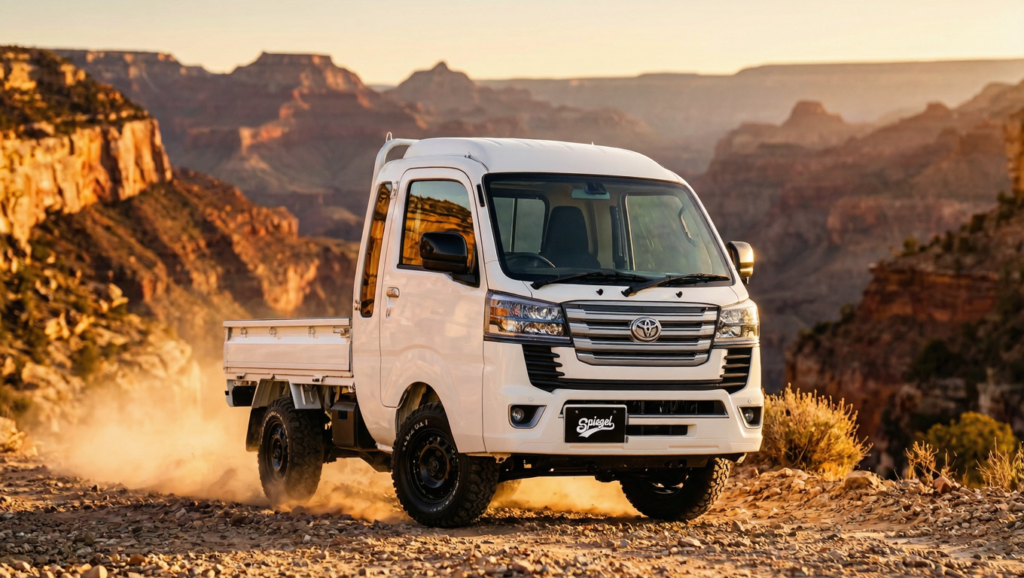
For U.S. and Canadian mini-truck enthusiasts, the most interesting part of this story is not immediate import potential but product direction. Many kei trucks currently popular in North America are older gasoline models imported under long-standing regulatory pathways for older vehicles. Suzuki’s farm trial shows that Japan’s manufacturers are now actively testing what an electric kei truck should do in the real world: quiet low-speed work, predictable route duty, and backup power capability.
This matters because one of the biggest questions in the kei truck market is whether kei trucks will remain mostly nostalgic, low-cost imports or evolve into a broader class of compact utility vehicles with modern safety and energy features. Suzuki’s test suggests that the latter path is at least being seriously considered.
The Bigger EV Commercial-Vehicle Context
Suzuki has already introduced the new e Every, a battery-electric kei commercial van. It features a 36.6 kWh battery, a WLTC-rated range of 257 km, and a starting price of 3,146,000 yen. Advanced safety equipment, including collision mitigation braking, is standard. The van also offers external power-supply functionality, suggesting that Suzuki is thinking beyond transportation alone and considering roles such as emergency backup power and energy support at worksites.
While Suzuki has not announced production specifications or pricing for a BEV Carry truck, the e Every serves as a useful benchmark. In other words, the company is no longer speaking only in broad, vague EV ambitions. It already has a production EV product on the market and is now testing how similar electrification could work in the kei truck format.
What This Means for Buyers, Owners, and Industry Stakeholders
For potential buyers, this news is best read as an early indicator rather than a shopping trigger. If you are waiting for an electric kei truck that can replace a gasoline model in every use case, this trial does not prove that yet. What it does show is that manufacturers understand the real use cases they need to solve: short daily routes, repeated stop-and-go operation, low noise, home or depot charging, and the value of stored electricity.
For existing owners, especially farmers and small business operators, the appeal is easy to understand. The success of battery electric (BEV) Kei trucks can reduce dependence on fluctuating fuel prices, minimize noise in residential areas or early morning work environments, and enhance their value as backup power sources during outages.
For dealers, suppliers, and fleet planners, it is crucial to recognize that electrification in the Kei truck segment may not begin as a one-size-fits-all replacement, but rather with strictly defined use cases.
Practical Concerns Still Remain
For current owners, especially farmers and small business operators, the appeal is easy to see. A successful BEV kei truck could reduce exposure to fuel-price swings, cut noise in residential and early-morning work settings, and provide added value as backup power during outages. For dealers, suppliers, and fleet planners, the more important takeaway is that electrification in the kei truck segment is likely to start with clearly defined use cases rather than a universal replacement strategy.
This is particularly important in the kei truck world, where owners tend to keep vehicles for the long haul and value economic durability more than novelty. If a BEV kei truck arrives with a significantly higher upfront price, uncertain resale value, or greater charging burdens, adoption may remain limited even if the driving experience is better. The trial itself suggests that Suzuki recognizes these open questions need real-world data rather than assumptions.
Safety and Ease of Use Matter as Much as Electrification
There is another point North American readers should not miss: utility buyers do not choose these vehicles on drivetrain alone. JAMA found strong demand for safety systems such as collision mitigation braking, pedestrian detection support, and unintended acceleration prevention. That lines up with the reality of kei truck use in aging rural populations and small businesses where ease of operation and damage prevention matter every day.
Even if electric mini trucks prove viable, success will depend on whether they offer modern safety, straightforward charging, clear maintenance support, and a cabin and cargo-bed configuration that genuinely suits work use. In the real market, “electric” is not the entire product story; it is only one part of it.
Who Is This Really For?

In practical terms, this kind of electric kei truck appears best suited to farms, campuses, facilities, local service fleets, and small operators with predictable daily mileage and access to regular charging. It makes the most sense where quiet operation, local-road use, and energy backup are genuine advantages.
It is less clearly suited to buyers who need long-range driving, sustained high-load use, minimal downtime, or a direct replacement for a gasoline kei truck in every situation. In short, it looks promising for users with specific, well-defined use cases, but not as a universal solution for the kei truck market as a whole.
What Comes Next
The most important result of this trial will not be a headline range number. It will be whether the vehicle can handle real farm schedules, seasonal changes, charging routines, and energy use without becoming a burden. If the answer is yes, electric kei trucks could first grow in niche but meaningful roles where small size, low-speed work, and energy flexibility matter most. If the answer is mixed, the kei truck segment may electrify more slowly than the kei van market.
Either way, Suzuki’s agricultural trial signals a change in the direction of the discussion. The focus is shifting from “Can an electric kei truck be built?” to “Can it actually handle daily farm work?” That is the right question, and it is why this story is worth watching outside Japan as well.
Editorial Note
For North American readers, the real significance is not immediate import hype. It is that Japanese kei truck manufacturers are finally testing electric commercial vehicles in the environments that will determine whether the product category truly works. If the real-world data is positive, future mini trucks may come to be defined not just by size and affordability, but also by quietness, safety, and energy efficiency.