Two listings can look like a simple choice between badges. One has the paint you like; the other already wears the wheels you planned to buy. Neither photograph tells you whether the two trucks are comparable.
Start by matching what each listing actually describes. This is a comparison worksheet for two individual vehicles, not an instrumented road test or a claim that one model wins on comfort, reliability or off-road ability.
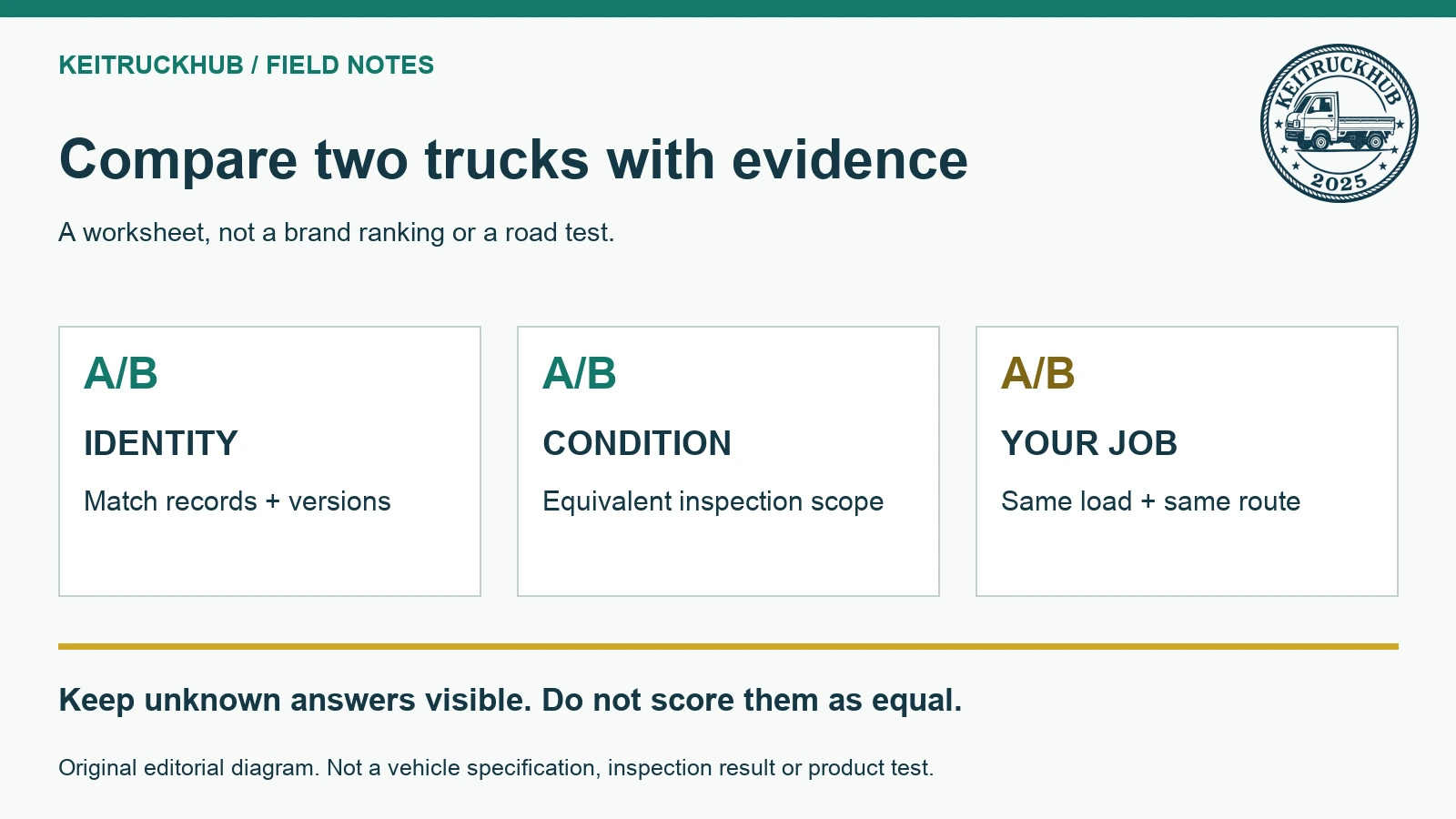
Compare two trucks with evidenceA worksheet, not a brand ranking or a road test.
- IDENTITYMatch records + versions
- CONDITIONEquivalent inspection scope
- YOUR JOBSame load + same route
Keep unknown answers visible. Do not score them as equal.
Match the Version Before Comparing the Badge
Record manufacture date, full chassis identification, cab type, drivetrain, transmission and modifications for each truck. Do not substitute a Jumbo or Super Carry layout for a standard-cab listing, or a current catalog for an older production version.
Daihatsu and Suzuki publish separate cabin and load-space information for their ranges. Use those references to learn what to ask, then obtain the period-correct documentation for the two actual vehicles.
Fill Both Columns With Evidence
| Decision | Truck A | Truck B |
|---|---|---|
| Identity and version | Copy from vehicle records. | Copy from vehicle records. |
| Cabin fit | Seat-position trial and measured storage. | Same trial, same occupant and gear. |
| Your largest load | Actual clear dimensions and applicable rating. | Same measurements and applicable rating. |
| Condition | Independent inspection and repair estimate. | Equivalent inspection scope and estimate. |
| Existing modifications | Part numbers, installer records and unresolved questions. | The same evidence, not a visual score. |
| Service support | Workshop acceptance and parts-source confirmation. | Workshop acceptance and parts-source confirmation. |
| Use in your location | Vehicle-specific import and local-use checks. | Vehicle-specific import and local-use checks. |
The empty answers matter. If one seller supplies records and the other supplies assurances, mark the second entry “unverified.” It is not automatically equivalent, better or worse.
Compare a Real Job, Not a Lifestyle Label
Choose one load you carry often and one awkward load you cannot avoid. Measure both, establish their weights, and work through loading and unloading on each candidate. Repeat the cabin check with your usual clothing and personal gear.
For example, a hypothetical gardener choosing between two inspected trucks might reject one because a regular crate does not fit its verified load envelope. A reader carrying smaller cases might decide differently. That is a use-case decision, not a universal brand ranking.
Price the Baseline Before the Mild Lift
Ask for the work needed on each truck in its present form. Then price any proposed modification separately. Non-original wheels and a lift can carry unanswered questions about hardware, clearance and installation; do not count them as free value until those questions are resolved.
If the goal is simply a visual style, it may be sensible to buy the better-documented unmodified truck and leave it alone while you learn its normal behavior. We have not verified a suspension kit or underguard application for either of your listings.
Use a Clear Stop Rule
Pause if the chassis identity is unclear, a required use cannot be confirmed, an inspection is refused, or essential repair costs remain unknown. A comparison chart should make uncertainty visible rather than disguise it with a numerical score.
Once those gates are answered, choose the vehicle that meets your actual requirements with evidence you can keep. Our listing-reading guide helps organize the seller’s documents; the Japanese mild-lift guide is a separate source of visual context.
Sources and Scope
- Daihatsu: current Hijet interior and load-space information
- Suzuki: current Carry and Super Carry interiors
- Suzuki: Carry and Super Carry load-space information
- NHTSA vehicle import guidance
- EPA vehicle and engine import guidance
Research-based editorial guide reviewed September 23, 2026 with AI assistance. This is not a hands-on vehicle test, an inspection, a quotation, or vehicle-specific legal or technical advice. Manufacturer references describe the versions shown on those pages, not every used truck bearing the same name.