The cheaper truck is not always the cheaper purchase. One seller includes transport to the port; another starts charging after the auction ends. Two attractive prices can describe two quite different deals.
Before choosing between them, put both quotations on the same basis: the exact truck, the same destination, the same currency, and a clear list of what remains unpaid. This worksheet is a way to find the gaps, not an estimate of today’s market price.
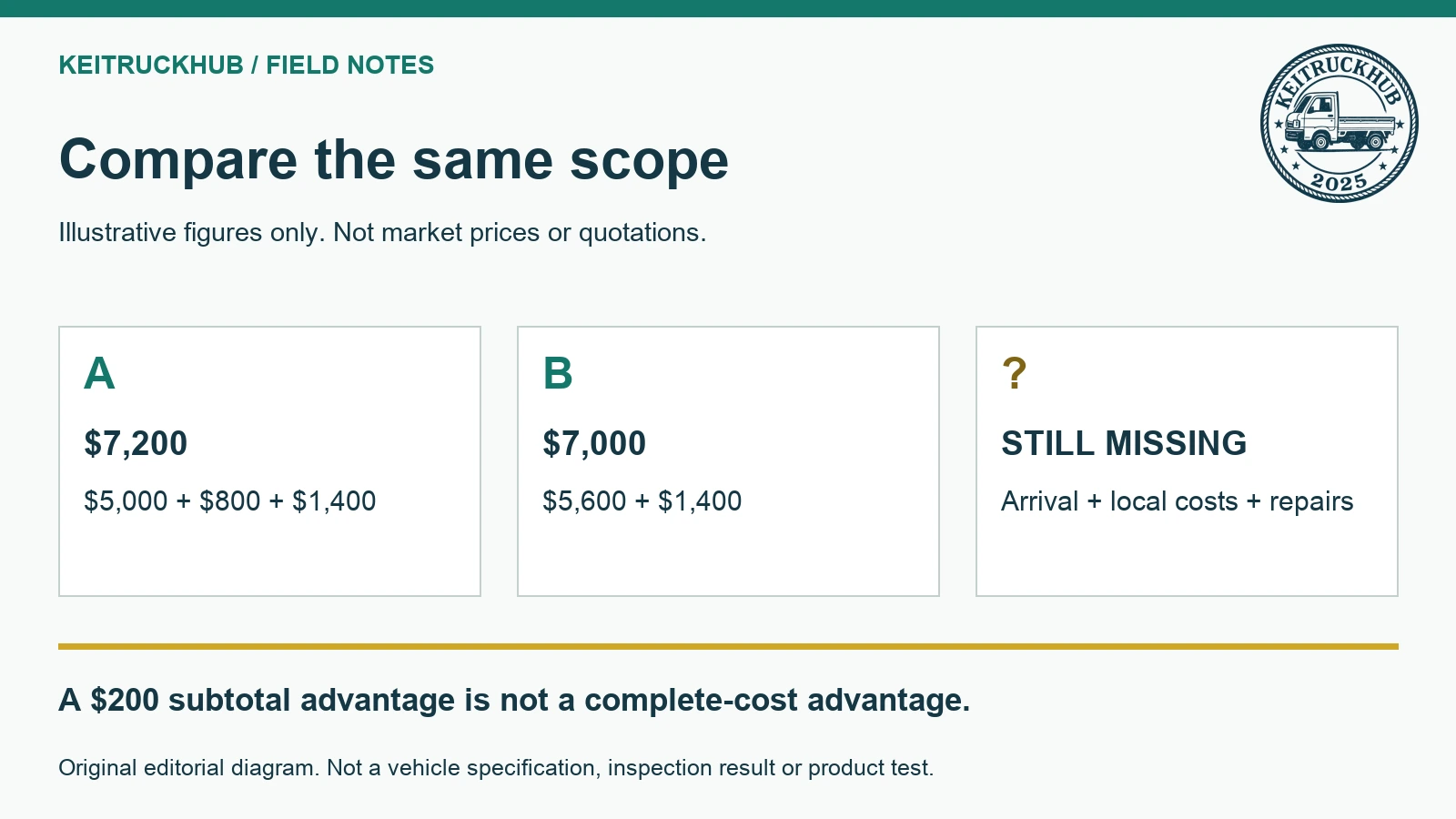
Compare the same scopeIllustrative figures only. Not market prices or quotations.
- $7,200$5,000 + $800 + $1,400
- $7,000$5,600 + $1,400
- STILL MISSINGArrival + local costs + repairs
A $200 subtotal advantage is not a complete-cost advantage.
Put the Two Quotes on the Same Basis
This page is for the moment when two quotations are already in front of you. It compares their scope and arithmetic. For identity papers, entry documents and the broader cost-and-responsibility checklist, use our before-payment document checklist first.
Label the offers A and B. Confirm that both use the same destination and delivery endpoint. A quote to the port cannot be compared directly with a quote delivered to your workshop. Keep vehicle condition separate: equal transport scope does not make the trucks themselves equivalent.
| Difference between offers | How to make it visible |
|---|---|
| A charge is bundled in one offer | Mark it included there, and add the corresponding separate charge in the other. Do not add it twice. |
| Only one offer includes onward delivery | Obtain the missing delivery quote to the same destination before comparing totals. |
| A charge has no amount | Label it unresolved and keep the subtotal explicitly incomplete. |
| One estimate has a different scope | Ask for matching assumptions or show the difference beside the number. |
A Worked Comparison: Why the Missing Boxes Matter
Illustrative arithmetic only: these invented figures are not vehicle prices, quotes or a recommended reserve.
| Same scope, same currency | Quote A | Quote B |
|---|---|---|
| Vehicle | $5,000 | $5,600 |
| Seller fees and Japan transport | $800 | Included |
| Freight and insurance | $1,400 | $1,400 |
| Known subtotal | $7,200 | $7,000 |
A starts $600 lower but its known subtotal ends $200 higher. Neither subtotal is a delivered, registered, repaired total: arrival charges, local costs and mechanical work are still missing. Do not choose B on this table alone; compare the trucks’ condition and the excluded items first.
Keep Currency and Repair Risk Visible
For a yen charge, record the yen amount and the exchange rate actually offered by the payment provider, including fees. Keep that conversion date beside the number. Converting a seller’s price with a search-result exchange rate can understate the payment you will make.
Separate known repairs from uncertainty. A written tire or brake estimate belongs among known costs. Rust that has not been inspected is not a small repair simply because no estimate exists. If the remaining budget cannot absorb unresolved work, pause and obtain better evidence rather than inventing a reassuring total.
Resolve the Difference Before Choosing
In the example, B’s known subtotal is $200 lower. That advantage disappears if B alone leaves out more than $200 of comparable costs. If either offer still has an unpriced essential item, neither has a complete total.
Send a focused question tied to the discrepancy: “Offer A includes delivery to the workshop, while your quotation ends at the port. Please quote that same delivery endpoint and confirm whether the handling already listed would be charged again.” Keep the original quote and the answer together.
If a supplier provides a written range, show a lower and upper subtotal using that range. Do not invent an upper bound for an uninspected repair or an unknown arrival charge. When the ranges overlap, price alone cannot establish a cheaper option.
Before payment, return to the document and responsibility checklist. A clean comparison does not establish import eligibility, local registration or the truck’s condition.
Sources and Scope
Research-based editorial guide reviewed September 23, 2026 with AI assistance. This is not a hands-on vehicle test, an inspection, a quotation, or vehicle-specific legal or technical advice.