Importing a kei truck to the U.S. may sound complicated at first. In reality, the process is much simpler than most people expect.
Thinking about driving a kei truck in the U.S.?
Federal eligibility: The 25-Year Rule for Kei Truck Imports
After import: Kei Truck Street-Legal Registration in the U.S.
State research: Kei Truck Street-Legal States: A State Research Guide
Once you understand the steps, importing a kei truck becomes a manageable and rewarding experience.
Step 1: Understand the 25-Year Rule for Kei Truck Import
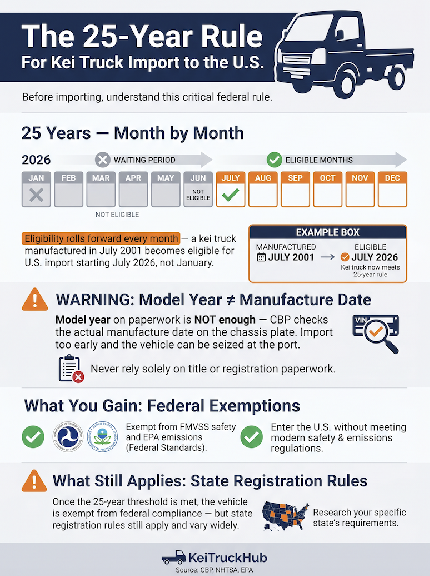
Before anything else, you must understand the 25-year import rule.
For NHTSA safety compliance, a nonconforming vehicle generally reaches the federal age exemption 25 years after its exact date of manufacture. EPA emissions eligibility is separate: the 21-year provision generally applies only when the vehicle retains an original-equivalent engine configuration.

NHTSA eligibility therefore rolls forward by manufacture date. For example, a truck manufactured in July 2001 reaches the 25-year NHTSA threshold in July 2026; its EPA eligibility and declaration code must still be checked separately.
NHTSA administers the federal safety import rules, while EPA administers emissions requirements. CBP reviews the entry documents at import, and the state later makes its own title, registration, and road-use decisions.
Step 2: Choose the Right Kei Truck Model
Next, you need to choose a vehicle.
Popular models include:
- Suzuki Carry
- Daihatsu Hijet
- Honda Acty
- Subaru Sambar
Many buyers prefer models from the late 1990s and early 2000s because they offer:
- Fuel injection
- Better reliability
- Optional features like air conditioning and 4WD
When buying from Japan, most people use import brokers or auction agents. These services provide inspection sheets, photos, and condition reports so you can make informed decisions.
Not sure which model to choose?
Read more: Best Kei Trucks for Beginners: Which Model Should You Buy?
Step 3: Arrange Shipping for Your Kei Truck
Once you purchase a vehicle, the next step is shipping.
Kei trucks are usually shipped via Roll-on/Roll-off (RORO) vessels.
Typical costs:
- $1,200 to $1,800 depending on destination
- West Coast ports (Los Angeles, Seattle) are usually cheaper
- East Coast shipping tends to be more expensive
Transit time: 2 to 4 weeks
Step 4: Handle Kei Truck Import Paperwork
This is the most technical step, but it can be simplified.
You will need:
- CBP Form 7501 (Entry Summary)
- DOT Form HS-7 (Declaration)
- EPA Form 3520-1
- Bill of Lading
- Purchase invoice
- Bill of Sale
Do not assume the same age exemption applies to both forms. Use the applicable declaration on HS-7 for NHTSA and the correct code on EPA Form 3520-1 only after confirming the vehicle’s age, engine configuration, and intended use.
Import Duty (Important)
A cargo kei truck is commonly classified under HTS heading 8704, where many light-truck subheadings have a 25% general duty rate. That figure may not be the total due: current Chapter 99 duties, exclusions, and the vehicle’s exact classification can change the entry calculation.
The exact rate that applies to a used kei truck can depend on:
- The vehicle’s HTS classification at the port of entry
- Any applicable Chapter 99 additional duties or exclusions
- The country of origin and the rules in effect on the entry date
Ask a licensed customs broker to confirm the HTS and Chapter 99 codes in writing before purchase. Vehicle age does not by itself create a tariff exemption.
Do not calculate landed cost from the 25% general rate alone; request a current entry estimate that includes every applicable duty, fee, and port charge.
Should You Use a Broker?
Many beginners hire a customs broker.
- Fees vary by shipment, port, bond, and service scope; request a written quote
- Optional, but recommended
- Helps avoid delays and mistakes
Step 5: Register Your Kei Truck in the USA
After clearing customs, you must register the vehicle in your state.
This step varies widely by jurisdiction.
Some states allow:
- Full road use
Others restrict use to:
- Low-speed roads
- Off-road / farm use only
Required documents typically include:
- Customs clearance documents (CBP Form 7501)
- DOT / EPA forms
- Bill of Sale
- Government-issued ID
- VIN inspection
Always contact your local DMV before importing. Kei truck registration laws vary significantly by state and can change without notice.
Read more: Kei Truck Laws in the U.S.: How Far You Can Drive
Step 6: Calculate Kei Truck Import Costs
Before importing, understand the full cost.
Typical breakdown (2026 estimates):
| Item | Estimated Cost |
|---|---|
| Vehicle | $3,000 – $7,000 |
| Shipping | $1,200 – $1,800 |
| Import duty | Up to 25% of vehicle value |
| Broker fees | $300 – $600 |
| State registration | $200 – $1,000 |
Total landed cost: roughly $6,000 to $11,000
Actual costs vary based on the port of entry, the vehicle’s condition, and your state’s registration requirements.
Want to understand the real value of kei trucks?
Read more: Why Kei Trucks Are Booming in America
Import Broker vs DIY: Which Is Better?
There are two main approaches.
Using a broker:
- Easier
- Less stress
- Higher cost
Doing it yourself:
- Cheaper
- More control
- Requires more effort
For beginners, a broker is usually the safest choice.
What to Expect After Importing
Driving a kei truck in the U.S. is a unique experience.
- Right-hand drive takes some adjustment
- Most drivers adapt within a few weeks
- Maintenance is mechanically simple
- Parts are widely available online
Ownership is easier than many first-time importers expect.
Final Thoughts
Importing a kei truck is not just a purchase — it’s an experience.
From browsing auctions in Japan to receiving your vehicle at the port, every step is part of the journey.
More importantly, a kei truck offers something rare today:
- Simplicity
- Affordability
- Character
If you’re willing to go through the process, the reward is a vehicle unlike anything else on American roads.
Related Reading
Read more: How to Make a Kei Truck Street Legal in the USA
Read more: Best Kei Trucks in the USA (2026 Guide)
Read more: Why Kei Trucks Are Booming in America
Read more: Kei Truck Laws in the U.S.: How Far You Can Drive
Sources
- U.S. Customs and Border Protection — Importing a Motor Vehicle
- NHTSA — Importation and Certification FAQs
- EPA — Learn About Importing Vehicles and Engines
- NHTSA — HS-7 Declaration Form
- USITC — Harmonized Tariff Schedule, Heading 8704
- EPA — Current Import Forms and Mini-Truck Reference Materials
Disclaimer
U.S. import regulations, tariff rates, and state registration requirements change frequently and can vary by port of entry and jurisdiction. This guide was checked against the official sources above in July 2026 and is intended for informational purposes only — it does not constitute legal, customs, or financial advice.
Duty rates in particular are subject to reinterpretation and policy updates; the figures shown are illustrative examples, not guarantees. Always confirm current requirements with U.S. Customs and Border Protection (CBP), your state DMV, and a licensed customs broker before initiating an import.
Written by KeiTruckHub Editorial Desk
Editorial review: Kei Truck Kingdom editorial team
Last updated: July 9, 2026