


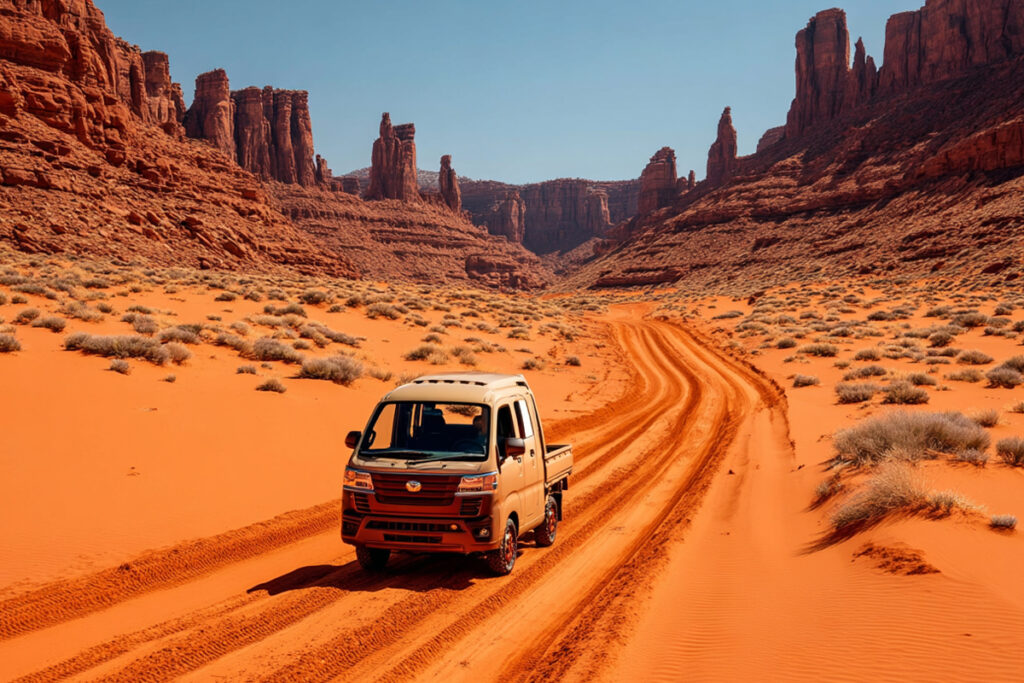
When we think of environmentally friendly vehicles, hybrids and EVs typically come to mind first. But “making the vehicle itself smaller” is another approach with significant environmental benefits. Mini trucks are a perfect example of this philosophy. In this article, we’ll examine mini trucks from an environmental perspective and explore how we should think about our relationship with vehicles.
In discussions about climate change and air pollution, technical topics tend to grab the spotlight. News about hybrid systems improving efficiency by X percent or the latest EV extending its range is easy to understand and generates excitement. But to truly reduce environmental impact, we also need to ask a more fundamental question: “Do we actually need a vehicle that large?” Mini trucks have answered this question from the field of practical use, demonstrating that “small vehicles can work just as hard.”
Looking at the manufacturing stage, as vehicles become larger and heavier, the demand for resources such as steel, aluminum, plastics, and rubber increases significantly. The extraction, refining, and processing of these materials consume vast amounts of energy and result in the emission of $CO_2$ and various pollutants.
The weight difference between a Kei truck and a full-size pickup truck can be several times over, and this impact should not be underestimated. Choosing the “minimum size necessary to fulfill the required functions” directly leads to reducing the overall environmental footprint throughout the vehicle’s entire life cycle.
In terms of fuel efficiency during operation, mini trucks are also a rational choice. Of course, being small doesn’t automatically make them environmentally friendly if driven carelessly, but when hauling the same load the same distance, a lighter vehicle consumes less energy. This is especially true in urban and rural short-haul applications, where full-size trucks often carry loads well below their capacity – leading to the realization that “we didn’t actually need a truck that large.” Mini trucks have filled this gap and been chosen by professionals in the field for decades.
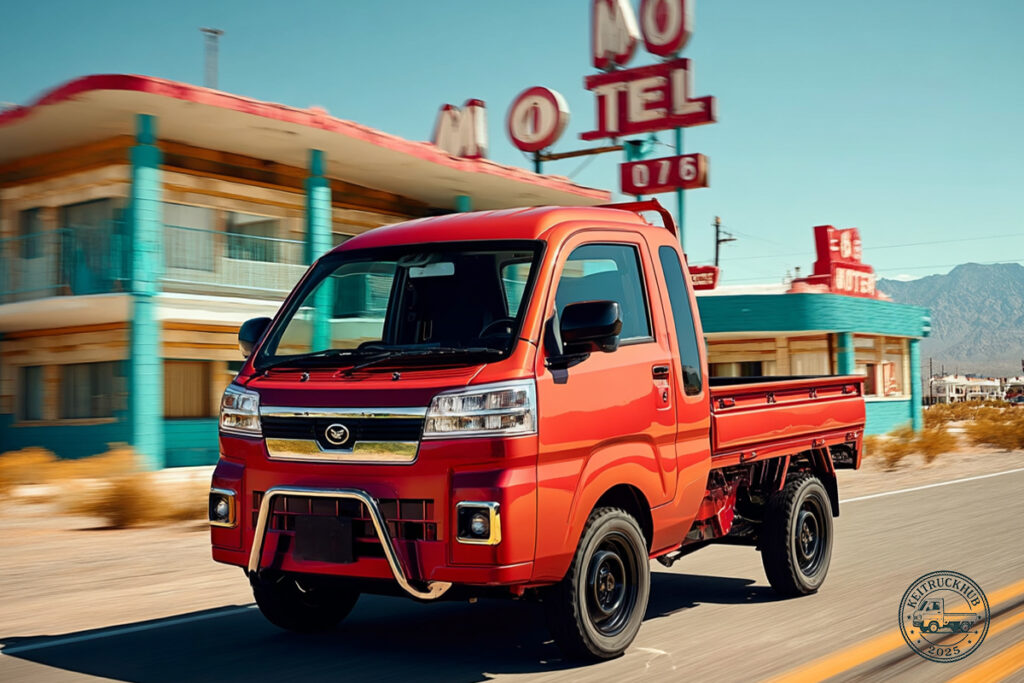
From an environmental perspective, “how long a vehicle can be used” is also a critical factor. Japanese mini trucks are built tough – with proper maintenance, they can work for 10, 20 years or more. Even after their first life ends, well-maintained units are exported overseas and find second lives on farms, construction sites, and campuses. When a single vehicle is used for a long time, it means “we don’t need to build a new one” – spreading the CO₂ emissions and resource consumption from manufacturing over many years. In this sense, mini trucks are actually remarkably eco-friendly products.
Kei trucks also pair naturally with local, community-based lifestyles. Rather than relying on massive shopping malls or distribution centers, local farm stands, small shops, and independent service providers use mini trucks to deliver goods and services within their neighborhoods. While this approach may be smaller in scale than giant logistics networks, it reduces wasteful long-distance transportation and brings people closer together – benefiting both the environment and community bonds. What mini trucks support isn’t just transportation, but “commerce with a face.”
Of course, Kei trucks are not without their challenges. Older diesel models, even with their small size, can impose a burden on local communities through exhaust emissions and noise. Overloading or aggressive driving accelerates the wear and tear on tires and brakes, releasing more particulate matter into the environment.
A low environmental footprint is always predicated on “proper use.” Therefore, to maximize the environmental benefits of Kei trucks, we must align regulations—such as vehicle inspections, emission standards, and noise controls—with responsible user behavior.
In recent years, the electrification and hybridization of Kei trucks have begun in earnest. Electric Kei trucks are perfectly suited for typical usage patterns, such as short-distance and scheduled routes. When combined with charging from renewable energy sources, they can significantly reduce $CO_2$ emissions.
Imagine an electric Kei truck quietly departing for the city from a facility equipped with solar panels and storage batteries. This is an iconic scene that simultaneously achieves “local production and consumption of energy” and “low-impact regional logistics.”
Environmental discussions often gravitate toward what we must give up or sacrifice. However, observing Kei trucks reveals a different approach: “rethinking form and scale while maintaining necessary functions.”
It’s not about banning large trucks, but rather asking, “Is a Kei truck sufficient for this task?” Optimizing toward the appropriate size is not about forcing sacrifice on anyone; it is a path that balances practicality with ecology.

Above all, kei trucks embody “ecology with a human face.” It’s not some abstract story about a massive power plant somewhere reducing CO₂ – it’s your neighborhood farmer, contractor, or delivery person efficiently moving about in a compact truck. Simply witnessing this gradually shifts our consciousness. Environmental issues can only be solved through the accumulation of individual daily choices. In that sense, choosing a kei truck and using it well is a small but tangible “vote for the environment.”
To make this more concrete, let’s consider a hypothetical example. Imagine a small suburban construction company that previously used a 3-ton truck for site visits and material deliveries. Now they’ve switched to using a kei truck for short-distance, frequent trips. The kei truck handles the multiple daily runs between the warehouse and job sites, while the larger truck only comes out a few times a week for bulk material deliveries. When you factor in not just fuel efficiency per mile, but also reduced idling time and fewer unnecessary “while we’re at it” hauls, the company’s CO₂ emissions and fuel costs could drop significantly.
When we expand the discussion of environmental issues from individual fuel efficiency to the structural optimization of entire operations, the Kei truck functions as an incredibly flexible “puzzle piece.”
In a multimodal transport system that integrates various modes—such as heavy-duty trucks, vans, Kei trucks, bicycles, and even walking—the Kei truck plays a vital intermediate role: offering high mobility while maintaining practical cargo capacity.
When designing an eco-friendly supply chain, determining where to deploy Kei trucks is not just a matter of cost. It requires optimizing the entire system, including local community cooperation and established business practices.
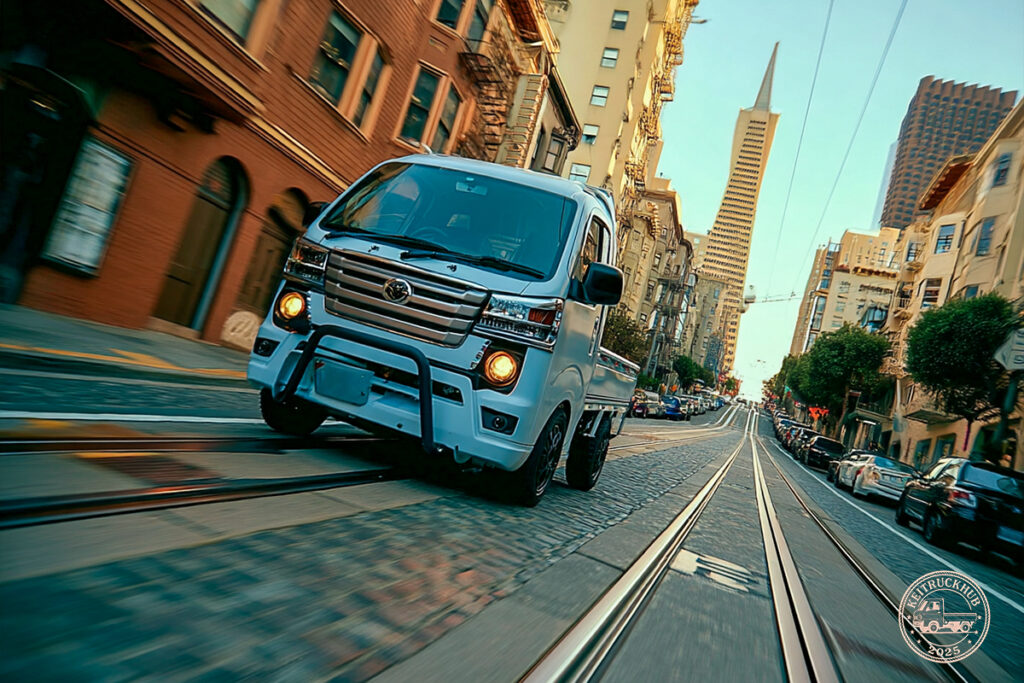
The environmental value of Kei trucks may have aspects that cannot be perfectly measured by numbers alone. However, the reason they resonate with so many people is that they embody a sensible approach: “choosing no more than what is necessary,” “repairing and using things for a long time,” and “selecting transportation suited to the local community and distance.”
In future environmental communication, it will be vital to shine a light on these clear, practical choices, rather than just promoting flashy new technologies.
A Kei truck is not just a convenient tool. It challenges us with fundamental questions: “How big should a vehicle be? How far should it travel? How much cargo should it carry?” Engaging with these questions is an indispensable perspective when considering mobility in an eco-conscious era.
Small, modest, yet incredibly hard-working, the Kei truck continues to quietly drive at the forefront of “practical ecology” in places where it often goes unnoticed.
🛻 Recommended Gear for Kei Truck Owners
Hand-picked products available on Amazon.
Nilight 18W LED Spot Off-Road Lights (2-Pack)
Super bright 1260LM - perfect for night trails and farm use.
View on Amazon →2-Inch Lift Kit - Suzuki Carry / Daihatsu Hijet
Compatible with DD51T, DB51T, S81P, S83P, S110P, S210P.
View on Amazon →Heavy Duty Multi-Use Cargo Net for Truck Bed
Stretchable bungee net - fits kei truck beds, ATVs, UTVs.
View on Amazon →* As an Amazon Associate, KeiTruckHub earns from qualifying purchases.