


Why Kei Truck Popularity in the USA Is Growing
Kei truck popularity in the USA has surged.
Japanese kei trucks have officially moved beyond niche curiosity and into something much bigger in the American market.
Import data shows a remarkable 300% increase over the past five years, with approximately 7,500 kei trucks entering the United States in 2024 alone. Just a few years ago, these tiny Japanese work trucks were still a fringe obsession. Now, they are showing up on farms, job sites, rural properties, and even suburban driveways across the country.
The Mini Truck Movement Is No Longer a Curiosity
To understand how quickly things have changed, it helps to look at the numbers. Roughly five years ago, only around 2,500 kei trucks were making the trip across the Pacific. Today, that figure has tripled, and industry observers believe tens of thousands of these small, durable trucks are already operating in the U.S.
That kind of growth matters because it signals something deeper than a passing novelty trend. Kei trucks are no longer being treated as strange imports for a few dedicated enthusiasts. They are increasingly being seen as real tools, real daily-use machines, and real alternatives to oversized American pickups.
The 25-Year Rule Opens the Floodgates
The surge is largely driven by the federal “25-year rule,” which exempts vehicles 25 years or older from U.S. Federal Motor Vehicle Safety Standards. That means 1990s-era kei trucks—Honda Actys, Suzuki Carrys, Daihatsu Hijets, and Subaru Sambars—are now freely importable.
In 2026, models manufactured in 2001 will become eligible for import, and in 2027, 2002 models will follow. As the range of eligible vehicles expands year by year, a steady supply of affordable and highly reliable mini trucks will continue to enter the U.S. market.
Why American Buyers Are Choosing Mini Over Mighty
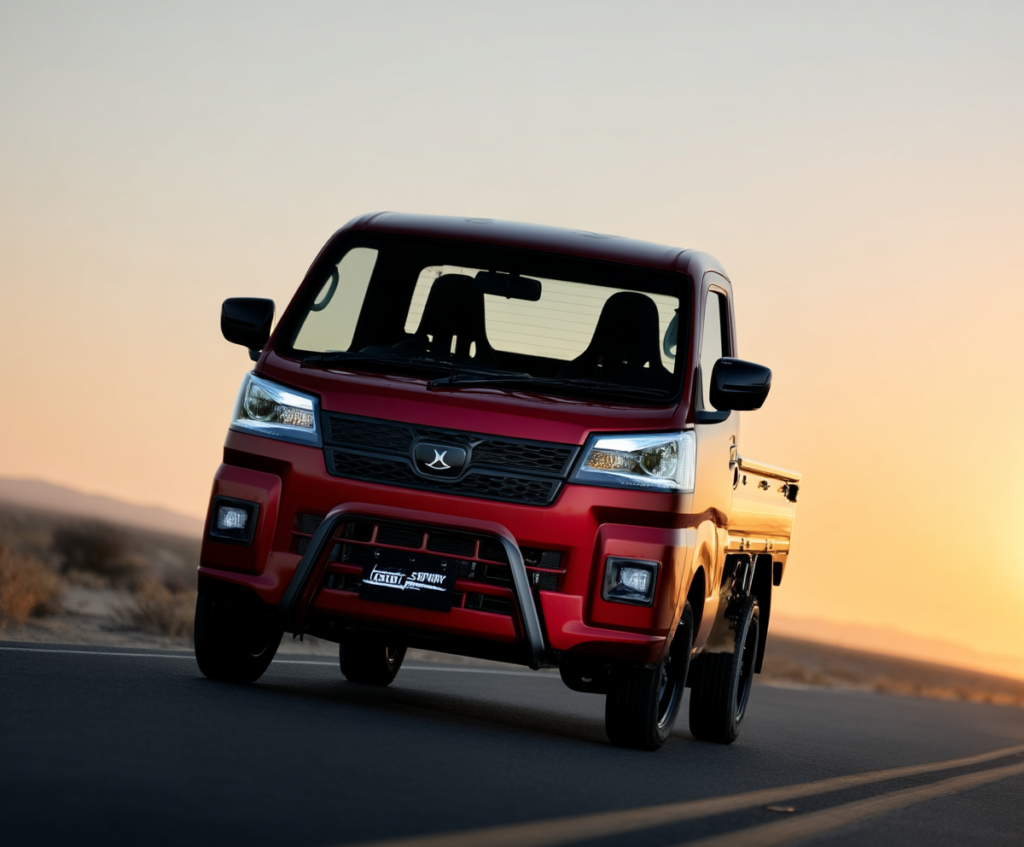
The appeal is not difficult to understand. A new full-size pickup in the U.S. now commonly costs more than $60,000, with well-equipped trims reaching $70,000 or even $80,000. By comparison, a landed kei truck—including shipping, customs, and broker fees—typically falls between $6,000 and $12,000. That price gap alone is enough to make many first-time buyers take the category seriously.
But the story is bigger than affordability. Kei trucks also offer a combination of traits that feels increasingly rare in the modern truck market:
– 40–50 MPG fuel efficiency
– Compact dimensions that work well in tight spaces
– A usable bed for tools, lumber, soil, camping gear, and daily hauling – Simple mechanical layouts with relatively low maintenance costs
That combination makes them especially attractive to orchard owners, small contractors, hobby farmers, landscapers, and buyers who want utility without committing to a giant vehicle.
A Practical Truck Can Still Have Character
One reason this trend feels different from a typical value-driven market shift is that kei trucks are not just cheap. They have personality. A Maryland grocery store owner interviewed by CNN said he sold his Toyota Tundra and replaced it with a 1998 Honda Acty, paying $5,000 for the truck and about $8,100 total with shipping and taxes. His conclusion was simple: it was the most practical truck he had ever owned. That kind of story explains a lot. Buyers are not just settling for something small. Many of them are finding that these trucks genuinely fit their lives better.
And once people start living with a kei truck, the appeal often goes beyond pure practicality. The right-hand-drive layout, compact proportions, mechanical honesty, and unmistakably Japanese character all help turn ownership into something more than transportation.
State Laws Still Complicate the Boom
Even so, the picture is not completely simple. Federal import legality does not automatically mean easy road use. State registration laws remain inconsistent, and that patchwork is still one of the biggest complications in the market. According to the source text, only 19 states currently allow kei trucks on public roads without major barriers, while states such as New York prohibit registration entirely. Others apply speed restrictions, such as 35 mph limits in Florida and Tennessee and 55 mph limits in Louisiana.
Still, there are signs of progress. Colorado has passed legislation recognizing kei vehicles for registration beginning in 2027, and Massachusetts clarified regulations in 2024 in ways that were welcomed by kei truck owners. So while the rules remain uneven, the broader direction is not entirely negative.
The Community Effect Is Real
Another reason the boom feels durable is that kei trucks now have a visible enthusiast ecosystem in North America. Instagram accounts, Facebook groups, YouTube channels, and forums like Reddit’s r/keitruck give owners a place to share import advice, maintenance tips, custom builds, and road-legal workarounds. The Kei Truck Appreciation Society on Instagram has grown to more than 113,000 followers, showing that interest in these vehicles extends far beyond a small handful of import specialists.
That kind of community changes the ownership experience. A kei truck is no longer an isolated oddball purchase. It is increasingly part of a recognizable subculture—one that includes lifted builds, dekotora-inspired customs, camper conversions, and serious work use.
What Is Driving the Boom?

Several forces appear to be working together at once. There is a growing pushback against the sheer size of modern American trucks. There is also rising interest in JDM vehicles, stronger environmental awareness, and a practical desire for lower-cost tools that still feel useful and interesting. Kei trucks sit right at the intersection of those forces. They are affordable, efficient, distinctive, and mechanically simple.
That is part of why the category feels so culturally alive right now. Buyers are not only making a rational choice. They are also responding to a different idea of what a truck can be: smaller, lighter, cheaper, and still genuinely useful. As one importer told CNN, the formula is hard to argue with: F-150-style utility, far better fuel economy, and lower insurance costs. For many buyers, that logic is becoming impossible to ignore.
The Road Ahead
With 2001 models now eligible and 2002 models arriving next, the import pipeline remains healthy. Japanese trade data cited in the source document notes that around 70,000 kei trucks were exported globally in 2023, with the United States accounting for a growing share of demand.
Politics may also affect the story going forward. Public comments from Donald Trump in late 2025 revived discussion around kei vehicle regulation, though the long-term policy picture remains uncertain. For now, the bigger truth is simpler: the mini truck movement is no longer fringe. It has become a visible part of the broader American conversation about trucks, utility, cost, and scale.
Related Reading
Editor’s Note
What makes this trend interesting is not just that kei trucks are cheaper.
It is that more American buyers are starting to realize they do not actually need a giant pickup to do truck things. Kei trucks offer a different kind of usefulness—one that feels lighter, simpler, and strangely refreshing in a market dominated by size and excess.
🛻 Recommended Gear for Kei Truck Owners
Hand-picked products available on Amazon.
Nilight 18W LED Spot Off-Road Lights (2-Pack)
Super bright 1260LM - perfect for night trails and farm use.
View on Amazon →2-Inch Lift Kit - Suzuki Carry / Daihatsu Hijet
Compatible with DD51T, DB51T, S81P, S83P, S110P, S210P.
View on Amazon →Heavy Duty Multi-Use Cargo Net for Truck Bed
Stretchable bungee net - fits kei truck beds, ATVs, UTVs.
View on Amazon →* As an Amazon Associate, KeiTruckHub earns from qualifying purchases.